- Upside
- Posts
- Issue #70: OpenAI Coming for the King
Issue #70: OpenAI Coming for the King
OpenAI's $20B Bet on the Chip Startup That Wants to Dethrone Nvidia plus Meta raises VR prices (blame AI), Snap cuts 1,000 jobs, and a $3.5B gaming platform shuts down for good.

Upside Team
April 24, 2026
In partnership with

Good afternoon.
Thanks for joining Upside.org's ~47,000 founders, limited partners, venture investors, and other subscribers for today's startup overview.
In today's issue: OpenAI bets $20 billion on a chip startup gunning for Nvidia, Meta hikes VR headset prices thanks to the AI boom, and a $3.5B social gaming platform says goodbye forever.
Let's get into it!
OpenAI Goes All-In on Cerebras — and It Could Reshape the AI Chip Wars
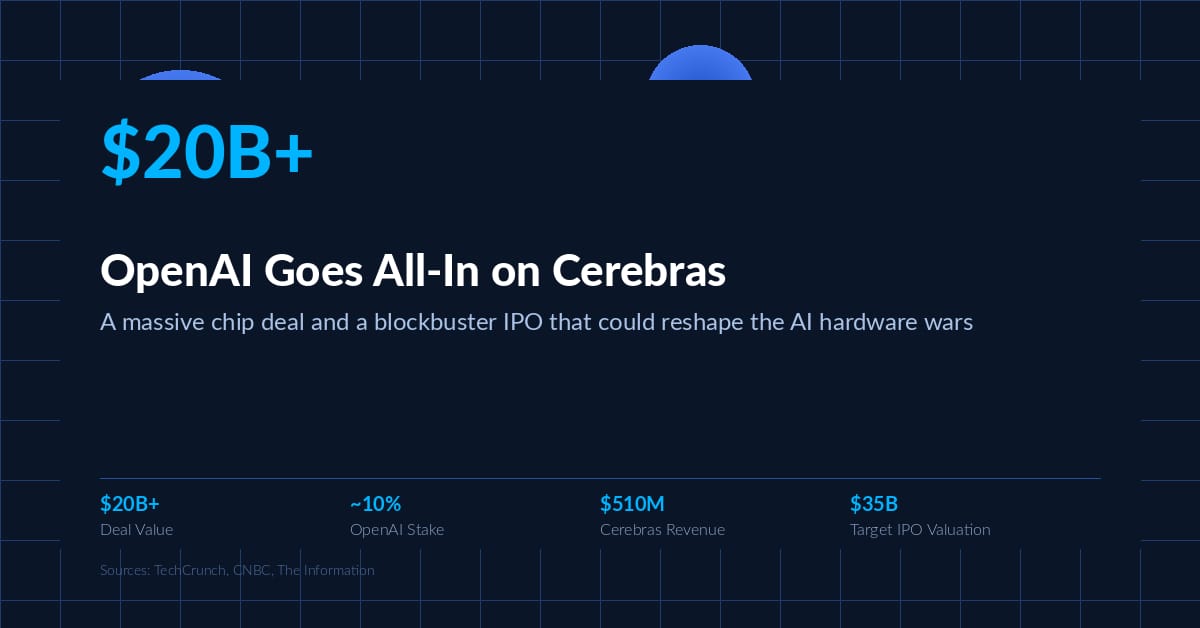
OpenAI Goes All-In on Cerebras — and It Could Reshape the AI Chip Wars
OpenAI will spend over $20 billion on Cerebras-powered servers over three years — and may walk away with a 10% stake in the chipmaker as it heads for a blockbuster IPO.
If you thought the AI infrastructure race was already intense, buckle up. OpenAI has doubled down on its partnership with Cerebras Systems, committing more than $20 billion over three years for server capacity powered by Cerebras's wafer-scale chips. That's double the $10 billion deal the two companies announced in January, and it comes with a sweetener: warrants that could give OpenAI up to a 10% stake in Cerebras as spending increases. OpenAI is also kicking in roughly $1 billion to help fund new Cerebras data centers. In short, this isn't just a procurement deal — it's a strategic marriage.
The timing is no accident. On April 17, Cerebras filed its public S-1 with the SEC, targeting a Nasdaq listing under the ticker "CBRS" as early as mid-May. The numbers are impressive: the company swung from a $484.8 million net loss in 2024 to $87.9 million in net income on $510 million of revenue in 2025. Morgan Stanley is leading the offering, and secondary-market pricing already implies a valuation north of $26 billion — up from $23 billion after its Series H. With OpenAI as its anchor customer and an IPO roadshow imminent, Cerebras is positioning itself as the most credible alternative to Nvidia's dominance in AI compute.
For the broader ecosystem, this deal signals that the biggest AI labs are serious about diversifying their chip supply chains. Nvidia still commands the lion's share of AI training and inference hardware, but OpenAI's willingness to bet $20 billion-plus on a challenger says volumes about where the market is heading.
Key Highlights:
Deal size: $20B+ over three years for Cerebras-powered compute, double the original January commitment. Total spending could reach $30 billion.
Equity angle: OpenAI receives warrants for up to a 10% minority stake in Cerebras, increasing with spending.
Cerebras IPO: Filed S-1 on April 17 targeting a mid-May Nasdaq listing at ~$35 billion valuation, aiming to raise $2-3 billion.
Financial turnaround: Cerebras posted $510M revenue and $87.9M net income in 2025, after losing $484.8M in 2024.
Tech edge: Cerebras's WSE-3 wafer-scale chip boasts 4 trillion transistors and claims 21x performance over Nvidia's DGX B200 at one-third the cost.
The AI chip wars are no longer a one-horse race. If Cerebras can deliver on its promises — and keep OpenAI happy — we could be looking at the most consequential IPO in the semiconductor space since Nvidia's own ascent. Watch this one closely.
Source: TechCrunch | CNBC
1,000+ Proven ChatGPT Prompts That Help You Work 10X Faster

ChatGPT is insanely powerful.
But most people waste 90% of its potential by using it like Google.
These 1,000+ proven ChatGPT prompts fix that and help you work 10X faster.
Sign up for Superhuman AI and get:
1,000+ ready-to-use prompts to solve problems in minutes instead of hours—tested & used by 1M+ professionals
Superhuman AI newsletter (3 min daily) so you keep learning new AI tools & tutorials to stay ahead in your career—the prompts are just the beginning
Quick Bites
Here are some interesting quick news items from the tech world:
Meta Hikes Quest VR Prices — Blame the AI Boom
Starting today (April 19), Meta is raising prices on its Quest VR headsets — the Quest 3S jumps $50 to $349.99 and the Quest 3 climbs $100 to $599.99. The culprit? A global memory chip shortage driven by insatiable AI data center demand from the likes of OpenAI, Google, and Microsoft. It's a vivid reminder that AI's hunger for silicon is rippling far beyond the data center, making everything from VR headsets to consumer electronics more expensive. Learn more.
$150M for Factory's AI Coding Droids
Factory, the AI coding startup behind autonomous "Droids" that handle testing, code review, documentation, and deployment, just closed a $150M Series C led by Khosla Ventures at a $1.5 billion valuation. The kicker: they've doubled revenue every month for the past six months, and customers include Nvidia, Adobe, and Palo Alto Networks. Keith Rabois of Khosla joined the board. If "AI replaces software engineers" has a poster child, Factory is it. Learn more.
Snap Cuts 1,000 Jobs, Says AI Made Them Do It
Snapchat's parent company is slashing 16% of its workforce — roughly 1,000 employees — in a restructuring that CEO Evan Spiegel says is driven by "rapid advancements in artificial intelligence." The bet: smaller teams armed with AI tools can do more with less. The layoffs are expected to save $500M+ annualized by H2 2026. Snap's stock popped 11% on the news, because Wall Street loves nothing more than efficiency gains spelled out in headcount reductions. Learn more.
Mintlify Hits $500M Valuation for AI-Powered Docs
Mintlify, the startup that uses AI to generate and maintain software documentation, raised a $45M Series B led by Andreessen Horowitz and Salesforce Ventures at a $500M valuation. With 20,000 companies on the platform and over 50% of its traffic now coming from AI agents (not humans), Mintlify is riding the wave of machine-to-machine documentation. Revenue hit $10M ARR in 2025 and is climbing fast. Learn more.
UK Bets £500M on Sovereign AI Champions
Britain launched its £500 million Sovereign AI Fund this week, making its first equity investment in AI infrastructure startup Callosum and offering supercomputer access to six additional startups. The fund acts as a government-backed VC, giving portfolio companies up to 1 million GPU hours, R&D support, and a direct line to government procurement. It's the UK's boldest move yet to keep homegrown AI talent from decamping to Silicon Valley. Learn more.
We’re obsessed with a new fun little tool that helps us learn interesting topics
via short SMS notes
Check it out at Lesson.co
In partnership with:

150 Million Users Weren't Enough to Save Rec Room
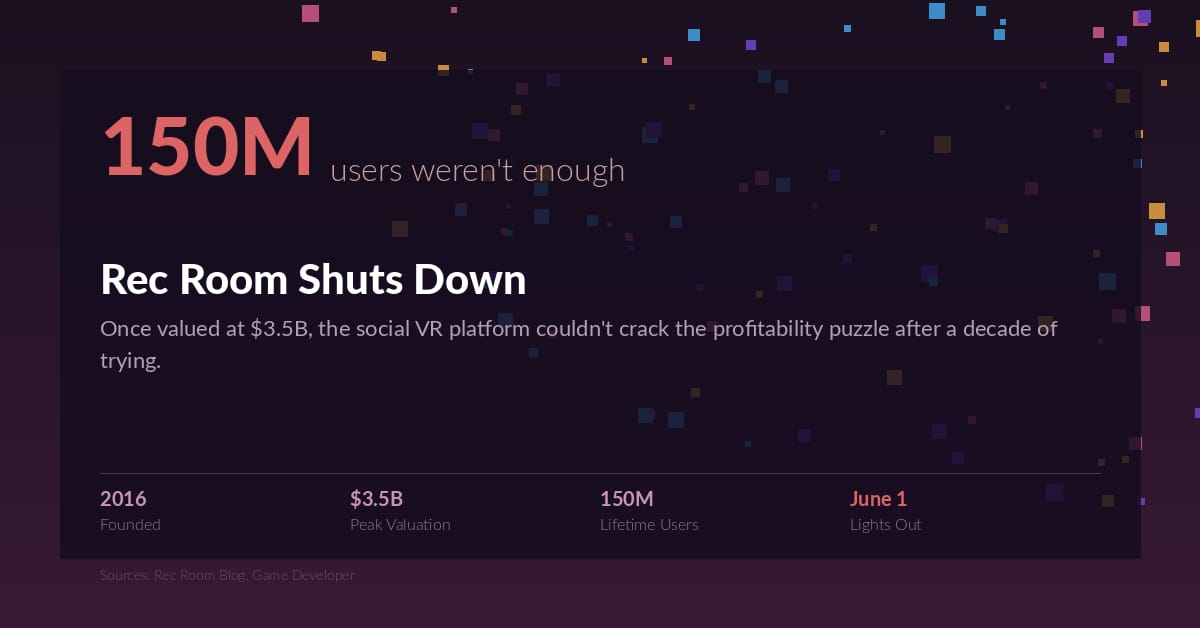
Once valued at $3.5 billion, the social VR platform is shutting down on June 1 after a decade of failing to crack the profitability puzzle.
Rec Room — the social gaming platform that let millions of people hang out, build worlds, and play together in VR and across devices — is calling it quits. The company announced on March 31 that it will shut down entirely by June 1, 2026, after concluding it could never make the business sustainably profitable. "Our costs always ended up overwhelming the revenue we brought in," the team wrote in a candid farewell blog post. Over its decade-long run, Rec Room amassed 150 million lifetime players and was valued as high as $3.5 billion. But big numbers on a dashboard don't pay server bills.
The warning signs were there. Two rounds of layoffs in 2025 cut the team from over 300 to roughly 100. Meta's strategic pivot away from VR gaming pulled the rug out from under one of Rec Room's core distribution channels. Snap has since acquired select Rec Room assets and talent for its XR glasses subsidiary, Specs Inc. — but the platform itself won't survive in any form.
Key Points:
Founded: 2016 in Seattle; grew to 150 million lifetime users across VR, PC, mobile, and console.
Peak valuation: $3.5 billion, with backing from prominent investors.
What went wrong: Costs consistently outpaced revenue; the unit economics of a free-to-play social VR platform never worked at scale.
Layoffs: 16% cut in March 2025, then ~50% of remaining staff in August 2025, leaving only ~100 employees.
Final chapter: Snap acquired select assets and talent; the platform shuts down June 1 at noon Pacific.
Lessons for Founders: Rec Room is a sobering reminder that user growth is not the same as a business model. 150 million users sounds incredible — until you realize that without a path to profitable unit economics, every additional user can actually make your problem worse. If your costs scale faster than your revenue, no amount of fundraising will save you. The team's decision to "close on their own terms rather than run the clock to zero" is a rare show of grace in startup-land, but the lesson is clear: figure out your path to profitability before you run out of runway, not after.
Source: Rec Room Blog | Game Developer

What did you think of today's email?Your feedback helps us create better emails for you! |